
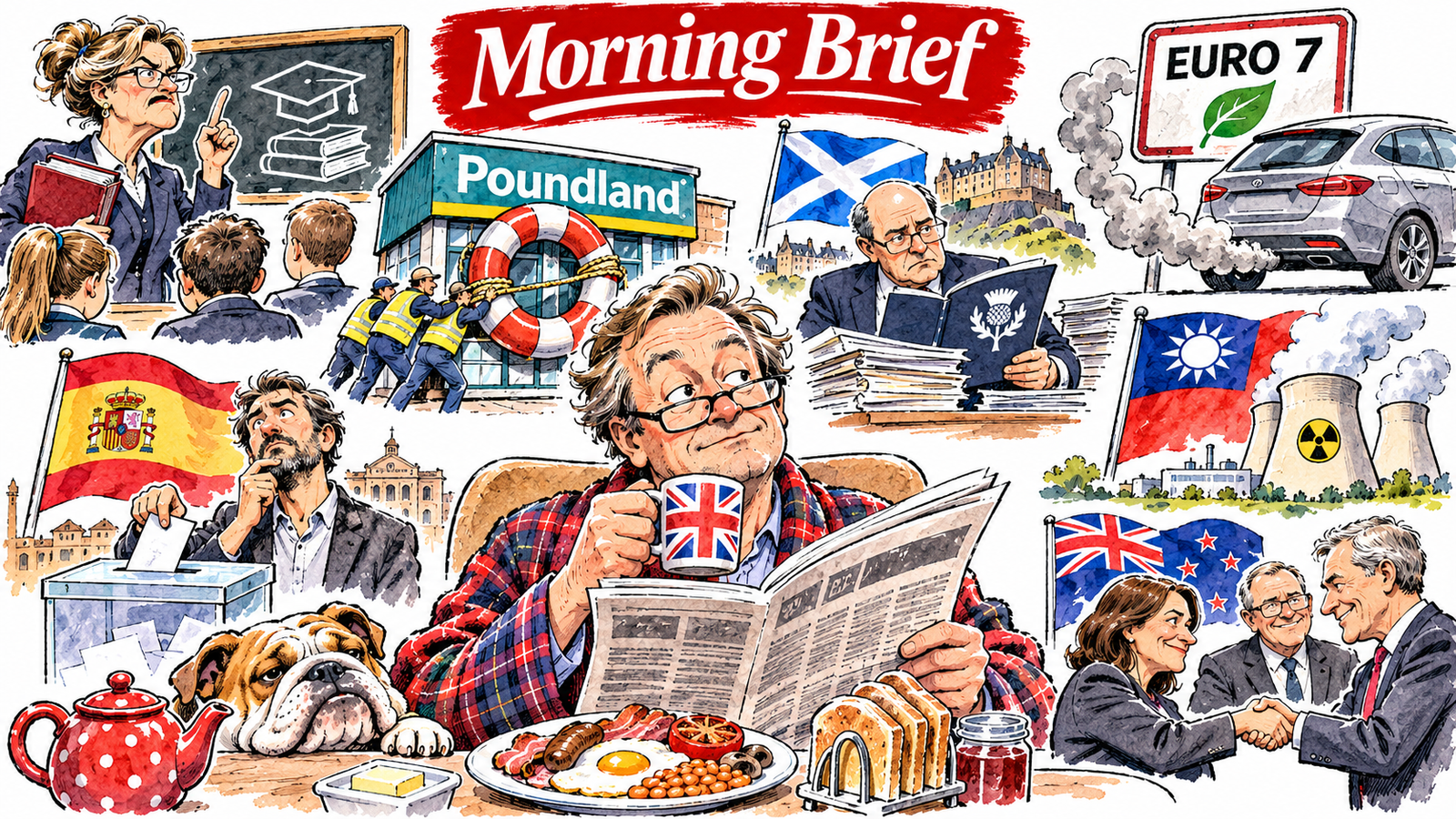
Good morning. England is preparing to teach children how to argue properly, New Zealand is looking for a parliamentary majority and Britain’s brakes have acquired international responsibilities. Seven stories for a Sunday that was supposed to be quiet.
01Children to learn how to disagree. Adults await a remedial course
Details of England’s planned curriculum reform emerged this morning. Ministers want pupils to develop financial, digital and media literacy alongside speaking and listening skills. Full plans are due to be presented to Parliament on Monday.
The syllabus will teach children to recognise dubious claims and disagree without turning the discussion into a personal feud. It is a bold experiment. If successful, a class of eleven-year-olds could be dispatched to Westminster to demonstrate the technique. MPs would be expected to bring a pencil and a willingness to listen.
Sources: Sky News, 29 November · Department for Education, 22 November · Tes, 29 November
02Poundland awaits a buyer with considerably more than a pound
Poundland entered administration on Wednesday. Its stores are continuing to trade while administrators seek buyers. Prospective bidders have reportedly been given until the end of this weekend to confirm interest, with the future of thousands of jobs uncertain.
For years, British shoppers have been encouraged to find value in the smallest purchases. It is rather unfortunate that the people buying entire retail chains now have to be reminded of the value of an actual functioning shop. The employees have already demonstrated an ability to keep the tills working. The boardroom’s contribution to the exercise remains less visible.
Sources: AlixPartners, 25 November · The Times, 28 November
03Scotland prepares its festive spreadsheet
The Scottish Budget for 2027 to 2028 is due on Thursday, 3 December. Finance Secretary Jenny Gilruth faces difficult spending decisions, according to economists, and Sunday’s press reports highlight competing pressures on public services. Detailed allocations have not yet been announced.
The first rule of a government Christmas is that everybody gets to write a list, but nobody is allowed to see the price of the other lists. Finance departments spend December explaining that the bicycle, the train set and the functioning public service cannot all fit inside the same stocking. The stocking itself is still under review.
Sources: Scottish Government, budget date · The Scotsman, 27 November · The Sunday Times, 29 November
04Cars face a new emissions test. Even the brakes are being questioned
EU Euro 7 requirements begin today for new types of cars and vans, including in Northern Ireland. The rules extend beyond exhaust emissions to matters such as brake particles and battery durability. Great Britain’s government has separately proposed applying Euro 7 to new light-duty registrations from November 2027.
The humble brake has spent decades doing its best work quietly, usually immediately after somebody says they can still make the lights. It must now contend with additional environmental scrutiny. Drivers need not panic: nobody is asking their existing hatchback to sit an examination this morning. Its owner can continue to fail the parking test entirely independently.
Sources: EUR-Lex, Euro 7 requirements · Department for Transport, government response
05Spain goes to the polls. The coalition calculator is warming up
Spain holds an early parliamentary election today after a period of political deadlock and disagreements over housing policy. Prime Minister Pedro Sánchez’s Socialists face a challenge from the conservative People’s Party, with polls suggesting Vox could be important in forming a government. Results are not yet available.
The Spanish election illustrates the peculiar distinction between winning an election and being able to govern afterwards. The former involves counting votes. The latter involves finding enough people who can occupy the same room without immediately objecting to the furniture. By tomorrow, the most important piece of equipment in Spanish politics may be a calculator with very large buttons.
Sources: Reuters, 29 November · Associated Press, 29 November
06Taiwan votes to revisit nuclear power. The switch is not quite that simple
Taiwan’s referendum on ending its nuclear-free energy policy passed on Saturday, according to reports published overnight. The result opens a route towards reconsidering nuclear generation, but safety assessments and other requirements remain before plants can operate again.
There is a considerable difference between voting to have electricity and persuading a power station to provide it. The latter involves engineers, inspections and rather more paperwork than the average household encounters when changing a light bulb. Anyone expecting a dramatic switch-on before breakfast may wish to give the engineers a little longer.
Sources: Focus Taiwan, 28 November · Associated Press, 29 November
07New Zealand’s government goes shopping for one more seat
Prime Minister Christopher Luxon held talks today with the centrist Opportunity Party after the final election count left his existing coalition one seat short of a majority. Opportunity won seven seats and could help determine the composition of the next government.
It is the parliamentary equivalent of inviting six people to dinner and discovering the table seats five. Suddenly the person who owns a folding chair has become central to the entire evening. The negotiations will determine whether everybody gets to sit down together or whether one party agrees merely to lend the chair on important occasions.
Sources: Reuters, 29 November · New Zealand Electoral Commission, 27 November